
Your formula is made from natural ingredients. Its packaging should tell the same story — not styrofoam or plastic, which is no longer compliant under the PPWR regulation.
Mycopor is a mycelium biocomposite that breaks down back into soil in 45 to 90 days. It grows from agricultural residues, not petroleum — so at the end of its life, it can return to the natural cycle.
Send us the dimensions of your bottle, jar, tube, or gift box. We create packaging that fits your product precisely.
🔵 PPWR Regulation (EU) 2025/40 has been in force since 12 August 2026
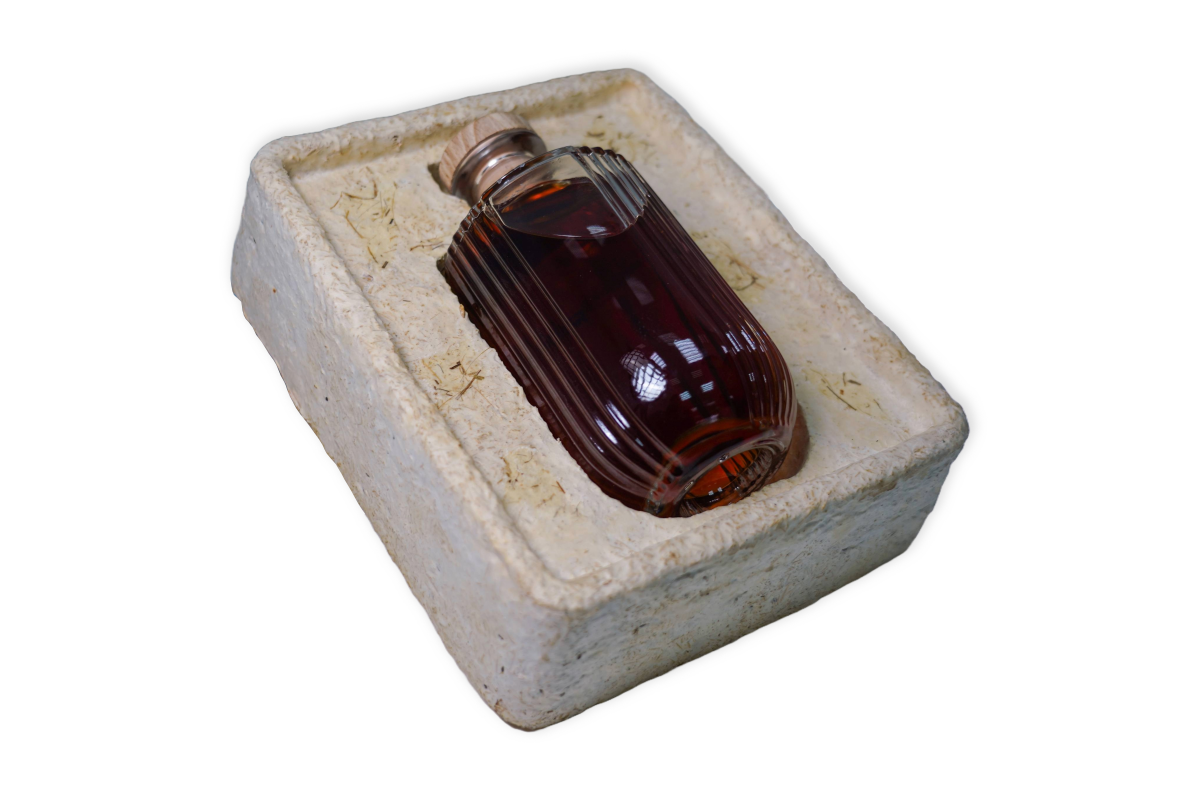
Mycopor — a material that (literally) grows into the shape of packaging.
WHERE THE PROBLEM ACTUALLY BEGINS
Look at the shelf of any premium natural cosmetics brand: a glass bottle, a minimalist label, a promise of clean ingredients.
Then you open the box — protective styrofoam, a plastic film over the cap, and a cardboard box that looks like every other one on the market.
Packaging is your product’s first touchpoint with the customer. Why should it tell a different story?
PPWR has made that gap visible.
Now you have the opportunity to close it.
If your product is natural, its protection should be too.
Mycopor grows from hemp, sawdust, and other local agricultural residues with the help of fungi — no petrochemicals, no synthetic foaming agents.
The result is a material with a soft organic texture, a warm natural color, and no plastic sheen — a look and feel that belongs next to premium cosmetics.
It doesn’t imitate nature. It is nature. Grown into the exact shape your product needs.
PROTECTION WITHOUT COMPROMISE
The first concern when packaging a bottle or glass jar is simple: will it arrive intact?
Mycopor’s mold isn’t cut from a standard block. Mycopor grows directly into the shape of your product, achieving an exceptionally precise fit and using almost all of the space around the glass.
As it grows, the fungus forms a dense, interwoven network of hyphae that binds the substrate fibers into a strong, lightweight biocomposite. The result is a natural protective cushion, comparable in performance to foam materials like EPS and PU foam — except it isn’t made from oil. It’s grown.
Your product stays protected. And after use, the packaging can become part of the natural cycle.
This isn’t just a theoretical claim. We’ve tested the material under more demanding conditions too. A surfboard core, laminated with bio-resin, withstood the load without delaminating, with less than 6% added weight compared to conventional PU foam.
If the material can handle that kind of stress, its protective role in shipping is even more convincing. Your product can stay safe on its way to the customer — without compromising on the material the packaging is made from.
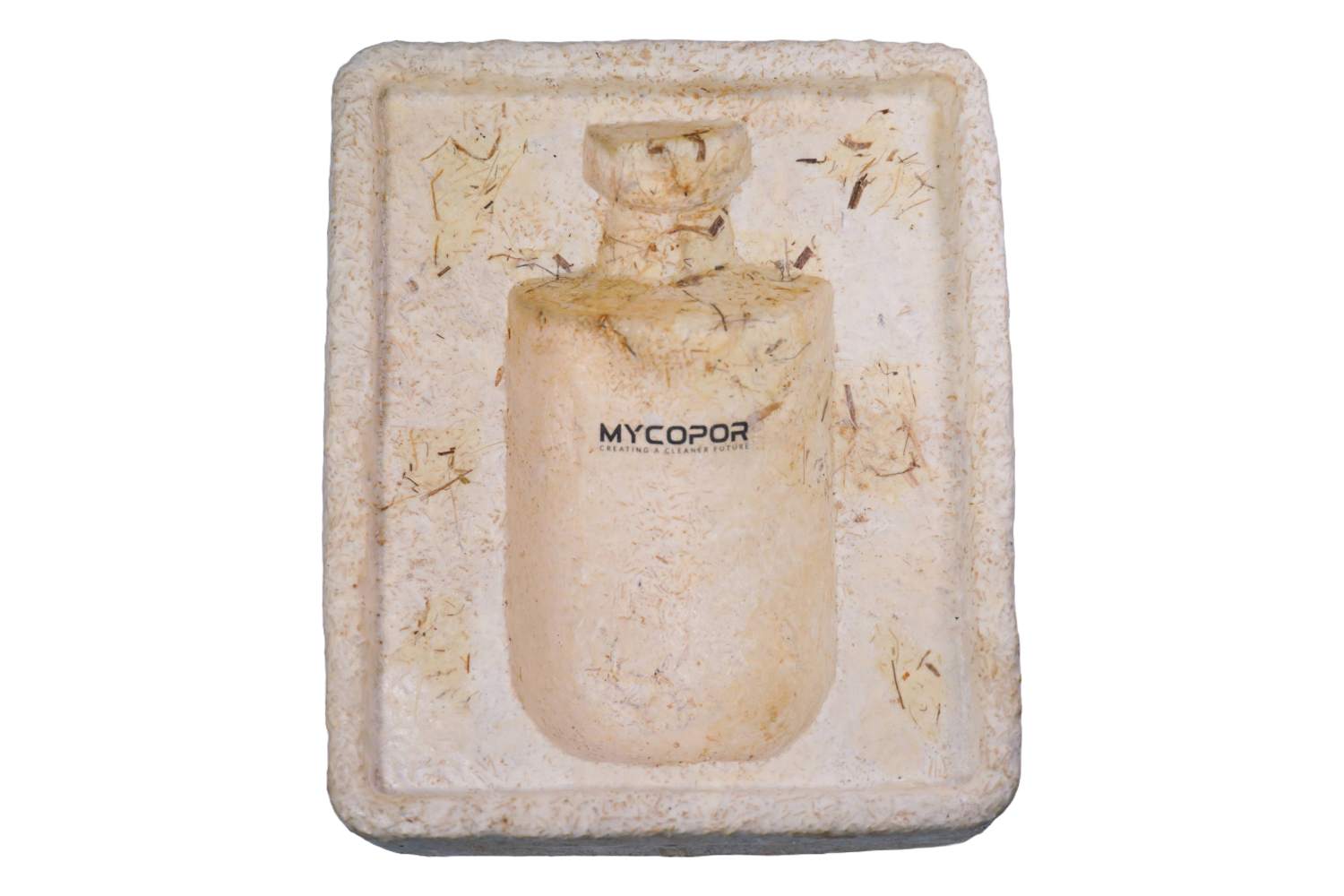
The mold grows precisely into the shape of the product — with minimal empty space, no additional inserts needed.
empty space around the glass
added weight compared to PU foam
compressive strength in laminated form
Compressive strength of the packaging material according to the technical data sheet: 140–450 kPa (EN 29469).
SAFE FOR THE FORMULA, SAFE FOR THE SKIN, SAFE FOR THE PLANET
Because Mycopor grows from plant fibers and fungi, its composition is fundamentally different from conventional synthetic foams. The material is free from PFAS (“forever chemicals”), heavy metals and formaldehyde (REACH Regulation (EC) No 1907/2006).
The air quality around your product matters too. The material does not emit volatile organic compounds (VOC) — especially important for packaging that sits close to skincare products or stays sealed in cardboard for weeks before opening.
With cosmetics packaging, it’s not just about what’s in the product. It’s also about what’s around it.
Its carbon footprint is part of the story too. Mycopor is made from plant fibers and fungi, and as it grows, part of the carbon from the biomass becomes locked into the material.
At the end of its life, uncoated packaging doesn’t have to become waste. It can break down in a home compost in 45 to 90 days, leaving no microplastics and acting as a soil nutrient, and production offcuts and scraps can be ground up and reused as up to 20% filler in the substrate for the next batch.
So the material’s journey doesn’t have to end in a landfill — it can return to the production cycle or to nature.
This isn’t just a closing line in a pitch. It’s a claim you can put right next to your ingredient list — even on your product’s own label.
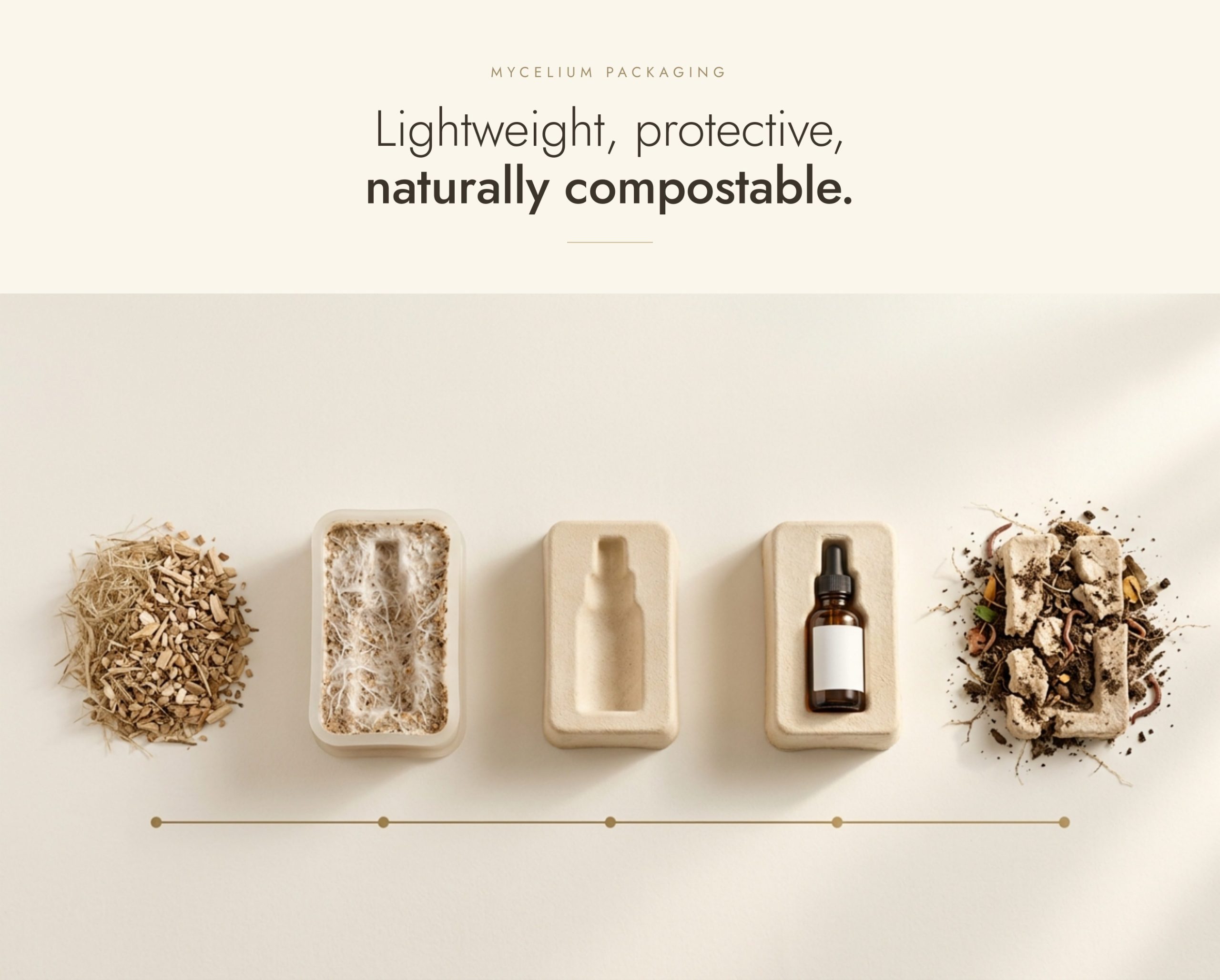
From agricultural waste to a finished product that, after use, breaks down in a home compost in 45 to 90 days.
THE QUESTION EVERY PROCUREMENT MANAGER ASKS QUIETLY
Let’s be honest: Mycopor isn’t plastic. We don’t extrude it through a mold where every piece could come out identical down to the thousandth of a millimeter.
The natural surface can vary slightly from piece to piece — similar to leather, marble, or wood, materials whose uniqueness and natural irregularities premium brands often highlight on purpose.
With Mycopor, this isn’t a flaw or a batch inconsistency. It’s proof of origin.
Every piece has grown, not been printed. And in that natural variation is something synthetic packaging simply can’t replicate.
A natural look doesn’t mean unpredictable quality. Nature is part of the process. Quality control is ours.
The look is unique. The function is verified. Every single piece — before it ever leaves the growth chamber.
Independent validation, not just our claim
This isn’t just our own assessment.
In August 2026, Mycopor received the Silver Slovenian Packaging Award 2026, presented by the Chamber of Commerce and Industry of Slovenia. The award was given at the AGRA fair in Gornja Radgona, one of the region’s most important agricultural and food trade fairs.
The packaging was judged by an expert panel with backgrounds in economics, design, and industrial visual communication, evaluated against independent professional criteria.
When you present Mycopor to your customers, partners, or management, you don’t have to make the case alone. An independent expert panel’s recognition backs it up.
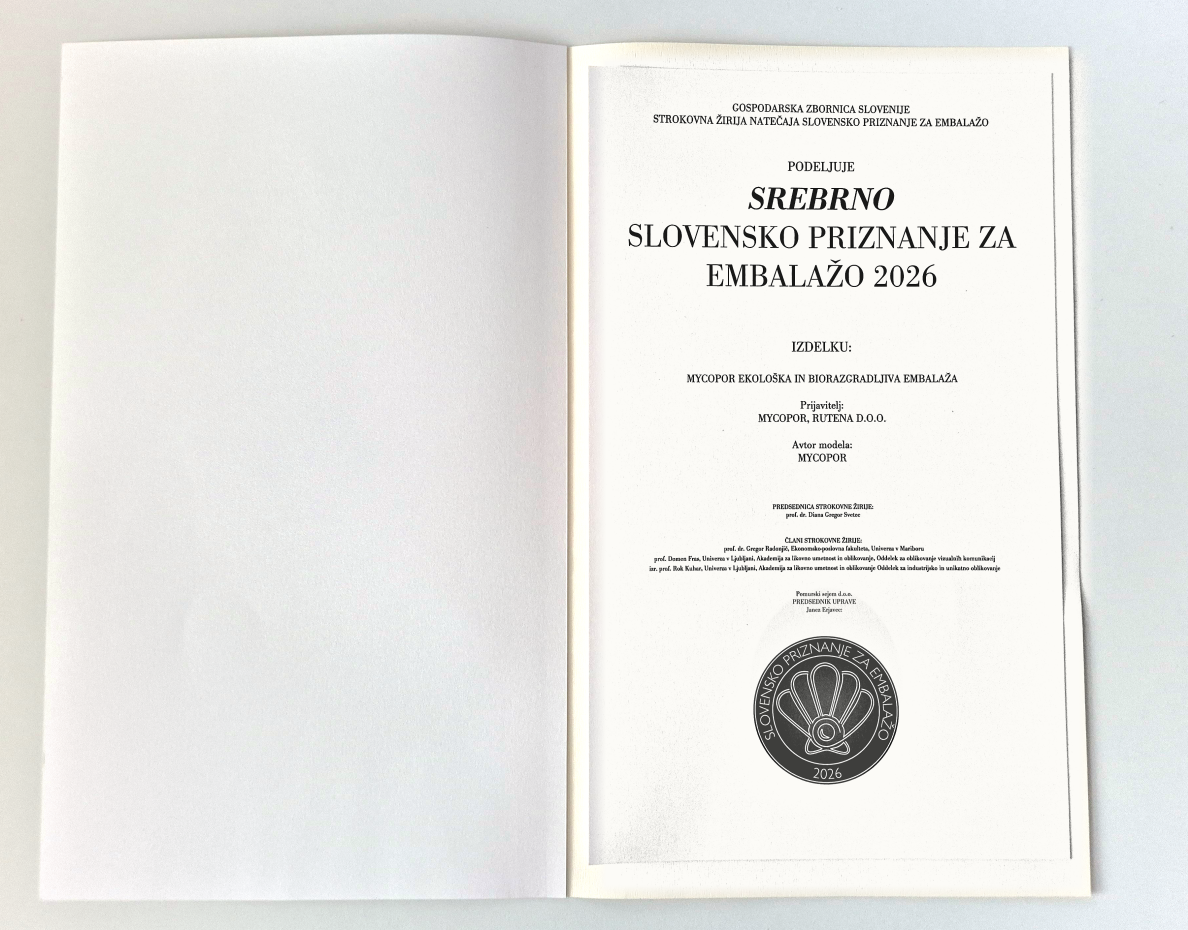
Silver Slovenian Packaging Award 2026, presented at the AGRA fair in Gornja Radgona — Chamber of Commerce and Industry of Slovenia.
ON PRICE, NO SUGARCOATING
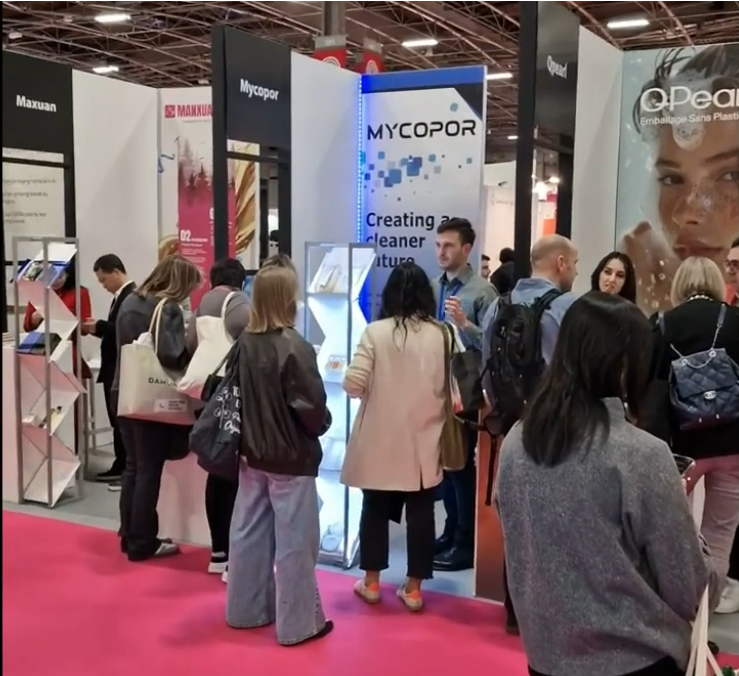
Mycopor at Paris Packaging Week 2025 — alongside leading premium packaging brands, not as a lab experiment.
Mycopor isn’t the cheapest packaging solution — and it doesn’t try to be.
It’s a natural material that grows in a custom mold, under controlled conditions in growth chambers, in smaller batches. That’s a different way of making it, and consequently, a different price category.
So it doesn’t make sense to compare it to the price of mass-produced plastic packaging from Asia. Compare it to luxury and premium packaging instead, where you’re paying not just for protection, but for material, design, experience, and story.
That’s when Mycopor’s value starts to make a lot more sense.
The market is already showing it’s willing to pay more for mycelium-based materials.
Certified mycelium acoustic panels, like those made by Mogu, sell at premium price points. The same holds for mycelium leather, like MycoWorks Reishi™, which has caught the attention of the luxury fashion industry and brands like Hermès.
Why? Because with materials like these, customers aren’t just buying function. They’re paying for distinctiveness, quality, material origin, and a story they can actually feel.
We want the same for Mycopor: sustainability shouldn’t just be a line on the label. Your customer can see it, touch it, and experience it the moment they open the packaging.
No large upfront inventory.
We manufacture Mycopor locally, in Slovenia. That means you don’t have to wait for a container from Asia, tie up capital in large stocks of EPS inserts in advance, or commit to the minimum quantities foreign suppliers require.
For a limited edition, a seasonal gift set, or a pilot batch, you can start small and see how the solution performs with your product and customers.
Once you know it works, we can scale production up quickly to match your needs.
Less risk at the start. More flexibility as you grow.
STRAIGHT TALK, BECAUSE THAT’S WHAT YOU’D EXPECT FROM A SERIOUS SUPPLIER
Mycopor is fundamentally a natural, compostable material, so uncoated it absorbs moisture. For internal cushioning inside packaging, that’s generally not an issue. But if the packaging will be exposed to water or high humidity — for example with bathroom products or shower ranges — we add extra protection.
According to the technical data sheet, water absorption is 0.8–1.5 kg/m² (EN 29767).
Under dry conditions, the material has an unlimited shelf life. Because it is thermally treated (dried), the fungi are completely inactive, so the material will not develop mold or rot on its own. We recommend storing it in a dry, covered area at relative humidity below 85%.
We apply a natural bio-resin coating made from plant extracts, which after just two applications reduces moisture absorption by roughly 70%. The material stays fully compostable and passes the strict EN 71 safety test for user contact.
For you, this simply means one extra step in production. As a result, lead time can be slightly longer, but we tell you upfront — so you can plan production and delivery ahead of time, without surprises when it arrives.
Industry-specific certification standards for mycelium packaging are still being harmonized at the EU level. Beyond the general EN and ASTM tests, which we already meet, more specific requirements for mycelium packaging are expected in the near future. The material’s measured properties according to EN and ISO standards are listed in our technical data sheet (PDF).
Until then, we take an individual approach, based on your market and intended use. Together, we determine what documentation and testing your product or customers require, and prepare the right documentation alongside your sample.
That means you get a solution tailored to your market’s actual requirements today — without waiting for new standards to be finalized.
WHAT THIS MEANS FOR YOU
For dry packaging — boxes, inserts, and gift sets — we can start right away, no extra steps needed.
If your product needs moisture protection, we include the natural bio-resin coating in the offer from the start. That way, requirements, price, and lead time are clear from the first conversation — no surprises later.
NEXT STEP
12 August 2026 has already passed. So the question is no longer when you’ll need to switch packaging, but how quickly you can do it — without stopping shipments or putting your supply at risk.
And the real reason to reach out today isn’t just compliance.
It’s the chance for your cosmetics packaging to finally tell the same story as the product inside it.
Tell us about your application and we’ll explore whether mycelium-based materials could be a suitable alternative.
We will use your information solely for the purpose for which we obtained your consent. We will use your personal information confidentially and will not forward it to third parties. Your privacy is treated in accordance with the GDPR and the Personal Data Protection Act.
From message reception, you can opt out at any time by sending a message to the email address: info@mycopor.eu with subject: Sign Out. After processing the request for cancellation, Rutena d. o. o. will stop sending content from which you have unsubscribed. For details on logging, processing, and protecting your personal information, please see Terms and services.
We will use your information solely for the purpose for which we obtained your consent. We will use your personal information confidentially and will not forward it to third parties. Your privacy is treated in accordance with the GDPR and the Personal Data Protection Act.
From message reception, you can opt out at any time by sending a message to the email address: info@mycopor.eu with subject: Sign Out. After processing the request for cancellation, Rutena d. o. o. will stop sending content from which you have unsubscribed. For details on logging, processing, and protecting your personal information, please see Terms and services.